
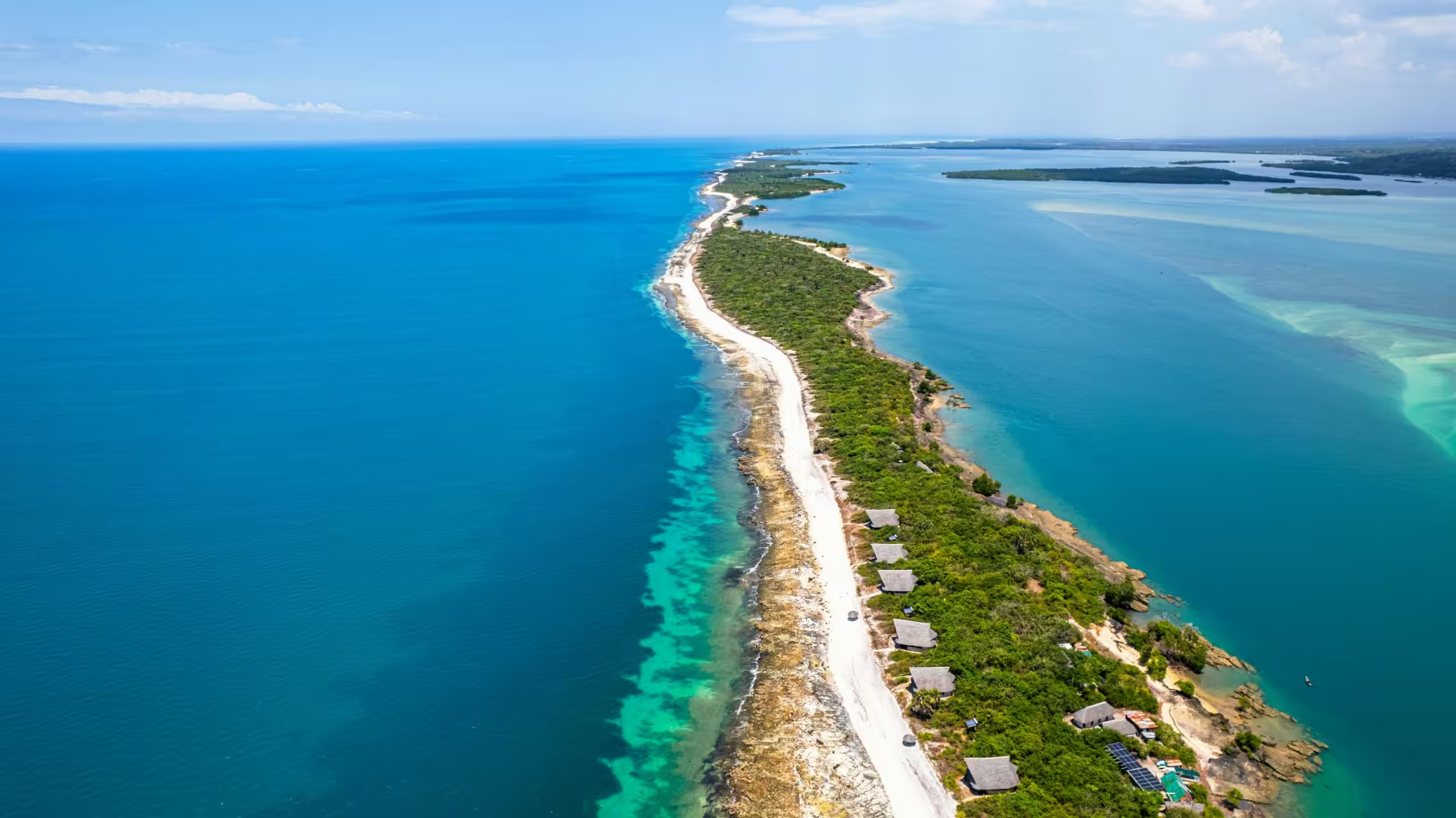
Zanzibar is one of the most searched real estate destinations in East Africa in 2026 — and for good reason. Tourism arrivals exceeded 917,000 in 2025, a 25% year-on-year increase, with forecasts pointing past one million visitors annually. Beachfront villas generate rental yields of 12–15%. Property values in premium areas like Nungwi and Paje are appreciating at 10–15% per year. And the government has introduced a Golden Visa residency programme that ties long-term residence directly to property investment.
But land law in Zanzibar is different from almost every jurisdiction foreign investors come from. Getting it wrong is expensive and hard to recover from. This article explains exactly how it works — from the constitutional framework and foreign ownership restrictions, through the full approval chain, to the costs, the Golden Visa, and the pitfalls to avoid.
1. The foundational rule: all land is government land
Every Zanzibar land transaction begins with this: all land in Zanzibar is vested in the Government of Zanzibar under the Land Tenure Act (Cap. 53, Laws of Zanzibar). There is no freehold ownership — not for locals, not for foreigners, not for anyone. What individuals and entities hold is a government-granted right to use and occupy land for a defined purpose, a defined term, and on defined conditions.
This is not a formality. It shapes every deal, every structure, and every risk in the Zanzibar property market.
2. Can a foreigner buy land in Zanzibar? The short answer is no — but here is what you can do
A foreign individual cannot be granted a Granted Right of Occupancy (GRO) — the primary land interest in Zanzibar — in their personal capacity. There is no mechanism for direct freehold-equivalent land ownership by a non-citizen.
What the law does provide is a structured leasehold pathway for foreign investors who meet the legal requirements:
- A foreign company incorporated or registered in Zanzibar (or mainland Tanzania, subject to Zanzibar recognition) may hold a leasehold interest in investment land.
- The company must be registered with the Zanzibar Investment Promotion Authority (ZIPA) under the Zanzibar Investment Act No. 10 of 2023 and hold a valid Certificate of Incentives.
- The minimum initial capital for a foreign company is TZS 100,000,000 (one hundred million Tanzanian shillings).
- The land must qualify as investment land, with a minimum plot area of 2,000 square metres.
- A foreign individual buying a unit in a ZIPA-approved condominium project under the Condominium Act (No. 10 of 2010) can obtain a title without needing to incorporate a company — this is the most straightforward pathway for individual buyers.
Critical warning
A foreign individual sold land through an informal arrangement — without a properly incorporated company, valid GRO, and ZIPA registration — holds no legally enforceable land right, regardless of what documents they receive. These arrangements offer the appearance of title, not the substance of it.
3. Types of land rights available
Granted Right of Occupancy (GRO)
The GRO is the primary land interest, granted by the Government for a specific purpose — residential, commercial, tourism, agricultural — for a term of up to 99 years (typically structured as 33-year blocks renewable to 99 years). It is registered at the Zanzibar Land Registry and carries conditions including annual land rent payment and development of the land within a defined period.
Derivative rights and sub-leases
A GRO holder can grant derivative rights — sub-leases and mortgages — to third parties, subject to Land Commission consent. Developers typically hold the GRO and grant sub-leases to individual unit purchasers. This is the standard structure for hotel, villa, and apartment sales in Zanzibar.
Condominium title
Under the Condominium Act 2010, a foreign individual can purchase a unit in a registered condominium project and receive a title registered in their own name — without needing to open a company. This is the most accessible route for individual residential buyers and is the basis for most modern apartment and villa projects.
Customary rights
Some land is occupied under customary rights recognised by the Land Tenure Act — rights arising from long-standing use and occupation rather than formal grant. Customary rights do not appear in the Land Registry but can subsist on apparently unencumbered land. On-the-ground investigation, engagement with the Sheha, and formal resolution of any claims are essential before proceeding.
4. The full approval chain: five tiers that cannot be skipped
Land acquisition in Zanzibar moves through five sequential tiers. Missing any one of them leaves the investor without a legally secure title.
- The Sheha — community confirmation
The government-appointed local administrator at shehia (village) level. Confirms physical boundaries, attests to occupation status, identifies customary claims, and issues the Sheha letter used in the formal application file. Without Sheha confirmation, District submissions are routinely rejected.
2. Survey & mapping — OCGS approval
A licensed surveyor carries out boundary demarcation and prepares the cadastral plan under the Survey Act (Cap. 71). The Office of the Chief Government Surveyor (OCGS) reviews and approves the plan. No GRO can be granted or transferred without an OCGS-approved survey plan confirming dimensions, area, coordinates, and plot number.
3. Government valuation — Chief Government Valuer
The Chief Government Valuer formally values the land, establishing: annual land rent, any premium payable, the stamp duty base, and compensation for customary rights extinguishment where applicable. The valuation certificate is a mandatory file document. Financial obligations it identifies must be paid or committed before Land Commission approval.
4. District Land Office — file verification
The complete file — Sheha letter, OCGS-approved survey plan, valuation certificate, applicant details, investment plan, and ZIPA Certificate — is submitted to the District Land Office for verification and forwarding to the Land Commission with a district recommendation. This is a substantive review, not a relay.
5 . Zanzibar Land Commission — formal approval
The apex authority under the Land Tenure Act. Must approve all GRO grants, GRO transfers, sub-leases, and mortgages. Written Commission approval is the legally operative step. No amount of positive indication from any other official substitutes for it. Commission approval enables registration; registration perfects the interest.
After Land Commission approval: the interest is registered at the Zanzibar Land Registry. Registration is what vests legal title in the holder. An unregistered transfer — however well-documented between parties — has no effect against third parties.
5. ZIPA registration: what it involves and why it comes first
For any foreign company acquiring investment land, ZIPA registration is a precondition — not a post-acquisition step. The Zanzibar Investment Act No. 10 of 2023, which governs ZIPA, replaced earlier legislation and enhanced ZIPA’s mandate and investor incentives. Registration requires:
- Company incorporation documents and Certificate of Incorporation.
- A detailed business plan and investment proposal for the proposed project.
- Evidence of minimum initial capital of TZS 100,000,000.
- Disclosure of beneficial ownership and directors.
- Employment and economic contribution projections.
ZIPA issues a Certificate of Incentives upon approval. Every foreign purchase must also pass through ZIPA, which issues a no-objection confirmation before the Land Commission registers the lease. ZIPA also issues the letter supporting the Golden Visa (Class C-11) residence permit application.
6. Transaction costs: what to budget
| Cost item | Rate / amount | Notes |
|---|---|---|
| Stamp duty | 1% of purchase price | Fixed rate under Stamp Duty Act (Zanzibar); calculated on Government valuation if higher than agreed price |
| Transfer duty | ~0.5–2% of price | Rate varies; recent regulatory changes aim to standardise. Budget 0.5–2% to be safe |
| Annual land rent | ~USD 1/m² rural; USD 5/m² prime coastline | Per 2024 Government Schedule; payable throughout GRO term. Non-payment is a ground for revocation |
| Premium (where applicable) | By Government Valuer assessment | One-off upfront payment, most common for tourism zone and prime commercial land |
| Survey costs | Variable | Mandatory; licensed surveyors only |
| Lease agreement fee (foreign entity) | ~TZS 1,000,000 | Government preparation fee |
| Legal fees | Negotiated | Zanzibar-licensed advocate required; foreign contracts signed abroad are unenforceable locally unless notarised and lodged in Zanzibar |
| Total closing costs (indicative) | 3–5% of property value | Hidden fees (approval documentation, coastal compliance, registration timing) can add a further 1–2% |
| Capital gains tax (on sale) | 10% resident; 20% non-resident | Withheld at source; strategic investment status can qualify for tax holidays |
| Rental income tax | 15% (non-resident rate) | Usually final withholding on gross rent |
7. The Zanzibar Golden Visa (Class C-11 residence permit)
Since May 2024, Zanzibar offers a Class C-11 Real Estate Residence Permit — widely marketed as the Golden Visa — administered jointly by ZIPA and the Tanzania Immigration Department. The programme does not confer citizenship or enhanced international mobility, but provides renewable two-year residency tied to property ownership.
Requirements
- Minimum investment of USD 100,000 in a single ZIPA-approved property (villa, apartment, or condominium unit).
- Property must be in a ZIPA-approved project — individual plots outside approved schemes do not qualify.
- ZIPA issues a recommendation letter confirming the investment qualifies.
- Application submitted through Tanzania’s e-Residence system with supporting documents including proof of investment, Zanzibar tax number, and police clearance from home country.
What it gives you
- Two-year renewable residency for the investor, spouse, and up to four children under 18.
- Permit fee: USD 550 (USD 300 for East African Community nationals); USD 50 per dependent.
- Freedom to travel in and out of Tanzania during the permit period.
- 50% reduction in capital gains tax when reselling the qualifying property.
- Tax benefits including ZIPA incentives available to registered investors.
- Renewable indefinitely while the property is held.
Important distinction
The Class C-11 permit is a stay permit, not a work or business permit. Separate work authorisation is required to take up salaried employment or run a business in Zanzibar.
8. Planning, environmental, and coastal requirements
All development requires planning permission from the Zanzibar Planning Commission before work begins under the Zanzibar Planning Act. Coastal and near-coastal developments — representing the majority of high-value investment in Zanzibar — require an Environmental Impact Assessment (EIA) under the Zanzibar Environmental Management Act (2015), administered by the Zanzibar Environmental Protection Authority (ZEPA). Coastal buffer zones range from 30 to 100 metres from shorelines; construction within these zones without ZEPA clearance can be halted or demolished.
9. The five pitfalls that catch foreign investors
1. Informal transfers
Unregistered property transfers have no legal effect under the Registered Land Act. “We’ll register later” arrangements leave buyers completely unprotected. A 2024 World Bank mission found approximately 42% of sampled sites had land-related issues including missing title deeds.
2. Nominee structures
Arrangements where a local person holds title with a private side-contract are legally vulnerable and frequently challenged. They do not provide the security of a properly structured corporate investment.
3. Skipping the survey and valuation
Only OCGS-approved survey plans are accepted by the Land Commission. Only the Government Valuer’s valuation governs for stamp duty and premium purposes. Neither step can be bypassed or approximated.
4. Under-declaring the purchase price
The government can void a transfer, levy penalties, or refuse registration if the declared price does not reflect true value. The official valuation slip from the Land Commission must be kept in the file.
5. Proceeding without Zanzibar-qualified counsel
Foreign contracts signed abroad are unenforceable locally unless notarised and lodged in Zanzibar. ZIPA, the Land Commission, the OCGS, the Sheha, and the District Land Office are distinct actors — navigating each tier without qualified local counsel materially increases delay and legal risk.
10. Legal framework reference
- Land Tenure Act (Cap. 53, Laws of Zanzibar) — all land rights, GROs, transfers, mortgages.
- Zanzibar Investment Act No. 10 of 2023 (ZIPA Act) — foreign investment registration, capital thresholds, investor incentives.
- Condominium Act No. 10 of 2010 — condominium title for individual foreign buyers.
- Survey Act (Cap. 71, Laws of Zanzibar) — cadastral surveys, OCGS approval.
- Land Transfer Act, 1994 — Land Transfer Board approval for transfers to foreign entities.
- Zanzibar Planning Act — planning permission and development control.
- Zanzibar Environmental Management Act (2015) — EIA requirements, ZEPA, coastal buffer zones.
- Stamp Duty Act (Zanzibar) — stamp duty on transfers and leases.
- Tanzania Immigration Act (Class C-11) — Golden Visa / investor residence permit.
About the author: Sunday Ndamugoba is a Partner at RIVE & Co, a corporate and commercial law firm qualified to practise in both Tanzania and Zanzibar. He advises developers, investors, and lenders on land acquisition, development structuring, ZIPA registration, and property financing. Contact: sunday@rive.co.tz | www.rive.co.tz
Legal disclaimer: This article is produced by RIVE & Co for general informational and thought leadership purposes only. It does not constitute legal advice and should not be relied upon as such. Laws, regulations, and regulatory positions referenced herein — including the Land Tenure Act (Cap. 53), the Zanzibar Investment Act 2023, and all related legislation — are subject to change. Readers are strongly advised to seek independent legal counsel qualified in Tanzania and Zanzibar law before taking any action in reliance on this publication. RIVE & Co accepts no liability for any loss or damage arising from reliance on this article. © 2026 RIVE & Co. All rights reserved.